
Trees
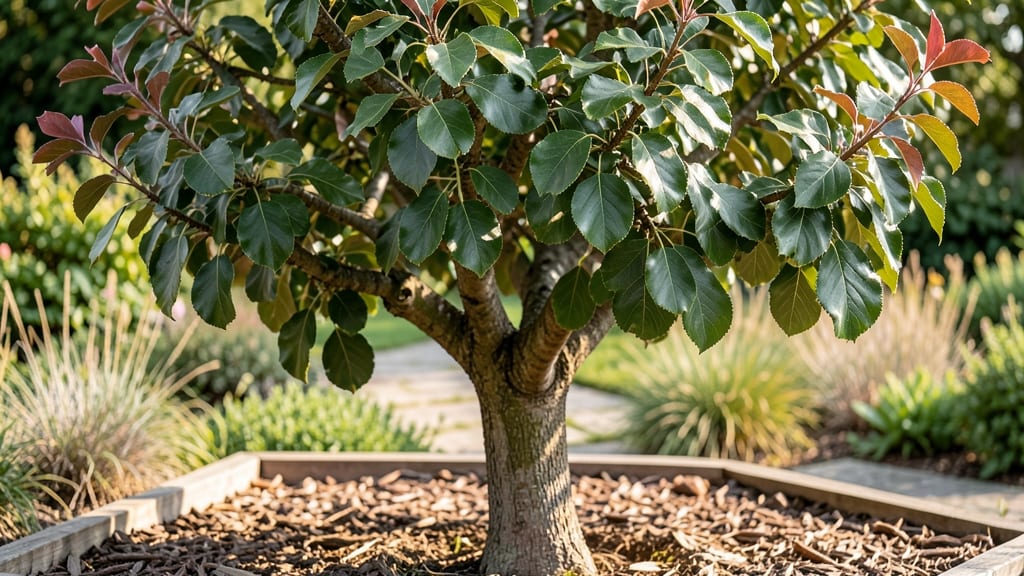
Pear tree leaves look like elongated ovals with smooth, glossy green surfaces and finely serrated edges that taper to a sharp point. They grow singly along branches in an alternating pattern, featuring a noticeable central vein with smaller veins branching outward.
These leaves are one of the easiest ways to identify a pear tree in your yard. 🌿 The glossy finish reflects light beautifully, especially when young, while their asymmetrical base (where the leaf meets the stem) helps distinguish them from similar trees like apple or cherry.
I've found that mature leaves often develop a slightly waxy texture that makes them feel almost slippery between your fingers.
The serrated edges aren't just decorative—they create tiny teeth that help channel water away from the leaf surface, which is why pear trees thrive in various climates.
Younger leaves start out a vibrant reddish-green before maturing to their classic deep green, giving you a visual timeline of the tree's growth cycle throughout spring and summer.
💡 In This Article
- Identifying Pear Tree Leaves: Key Botanical Features
- How to Distinguish Young vs Mature Pear Tree Leaves
Identifying pear tree leaves: key botanical features
The shape of pear tree leaves is what immediately catches the eye—typically measuring 2 to 4 inches long by 1 to 2.5 inches wide, they form an oval or elliptical silhouette with a distinctive pointed tip.
This shape creates a graceful arc along the branches, especially when viewed from above. The edges aren't just serrated—they have fine, sharp teeth that resemble tiny saw blades, each about 1/16 inch apart.
These serrations help prevent water from pooling on the leaf surface, which explains why pear trees often stay healthier during rainy seasons compared to trees with smoother leaf edges.
The leaf's asymmetrical base is a game-changer for identification. When you look at where the leaf stem meets the leaf blade, one side is noticeably longer than the other—a feature that sets pear trees apart from their apple cousins.
Apple leaves tend to have a more symmetrical base, while cherry leaves often have a rounded tip rather than the sharp point of pears.
The prominent midrib running down the center is another clue, with finer veins radiating outward at angles of about 45 degrees, creating a delicate web pattern that's visible even from a distance. 🌿
Sunlight plays a crucial role in the leaf's appearance. In full sun, pear tree leaves develop a deep, glossy green hue that almost shimmers when light reflects off their waxy surface. This waxy coating isn't just for show—it helps reduce water loss during hot days.
In partial shade, leaves may appear slightly lighter in color, sometimes with a duller finish, though they'll still maintain their characteristic shape. The glossiness also makes them feel slightly slippery to the touch, a tactile clue that's hard to miss when running your fingers along the leaf's surface.
Comparing pear leaves to similar trees reveals key differences. Apple tree leaves, for example, tend to be more broadly oval with a more rounded tip, while cherry leaves are often more elongated with a more pronounced serration pattern.
The vein structure in pear leaves is also more delicate, with fewer prominent secondary veins compared to the bold network you'd find on a walnut tree.
These subtle differences become more apparent when you examine the leaves up close, especially during the tree's active growing season when new leaves are emerging.
One fascinating detail is how the leaf's serration pattern changes with maturity. Young leaves start with more pronounced, almost jagged teeth that soften as the leaf grows, creating a smoother serration by midsummer. This progression gives you a visual timeline of the tree's growth cycle.
The glossy finish also tends to fade slightly as leaves age, though they'll still maintain their distinctive shape and vein structure throughout the season. 🌱
For those trying to identify a tree from a distance, focus on these three key features: the pointed tip, the asymmetrical base, and the delicate vein pattern. These characteristics create a signature look that's hard to confuse with other common trees.
The combination of shape, edge details, and vein structure makes pear tree leaves one of the most recognizable in the orchard or backyard.