
Planting
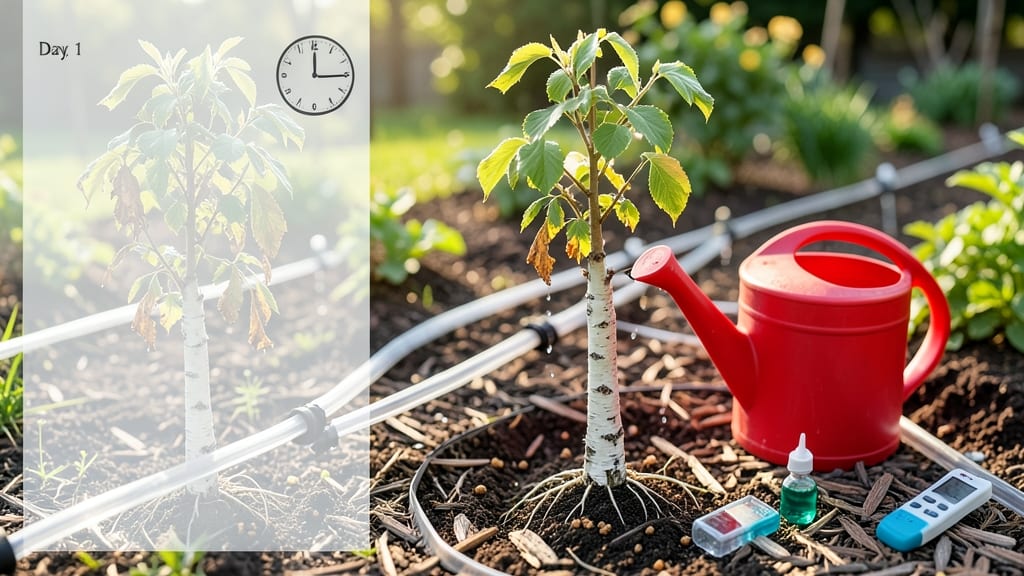
The recovery time for tree transplant shock ranges from 2 weeks to 2 years, depending on the species, with deciduous trees like maples and oaks generally adapting faster than evergreens such as pines or spruces. Seasonal timing and proper aftercare—like regular watering and mulching—play critical roles in reducing stress and speeding up recovery.
This variation in recovery time comes down to how each tree handles stress.
Deciduous trees, for example, have evolved to manage seasonal changes, so they bounce back quicker when transplanted during their dormant phase. 🌳 Evergreens, on the other hand, stay active year-round, which makes them more vulnerable to shock—especially if moved outside their natural growing season.
I’ve seen young willows recover in as little as 4 weeks with the right care, while mature conifers can take over a year to stabilize.
What’s often overlooked is how root damage during transplanting compounds the stress. Even with careful handling, roots get severed, disrupting the tree’s ability to absorb water and nutrients. That’s why I always recommend adding mycorrhizal fungi to the planting hole—it helps rebuild the root microbiome faster.
Mulching with organic material also insulates the roots and retains moisture, which is crucial during the first critical weeks after transplanting.
💡 In This Article
- How Tree Species Affect Transplant Shock Recovery
- Speeding Up Tree Transplant Recovery with Proven Care Steps
How tree species affect transplant shock recovery
Deciduous trees recover faster because their dormant seasons naturally reduce metabolic stress. During winter, they shed leaves to conserve energy, which means transplanting during late fall or early spring—when they’re already in a low-activity state—minimizes shock.
For example, a red maple can show new growth within 4-6 weeks if transplanted in early spring, while an oak might take 3-6 months due to its deeper, more complex root system. Their broad leaves also allow them to photosynthesize quickly once active, accelerating nutrient production.
Evergreens, however, face a different challenge: they’re always photosynthesizing, even in winter. This constant activity demands steady water and nutrient uptake, which is disrupted during transplanting.
A blue spruce, for instance, may take 12-18 months to fully recover because its needle structure requires more water per square inch of foliage. Conifers also have fine, fibrous roots that are easily damaged, slowing their ability to re-establish soil connections.
The 3-5 years needed for mature pines to stabilize reflects this biological trade-off.
Root structure plays a critical role too. Deciduous trees like birches have shallow, widespread roots that regenerate quickly, while evergreens often develop deep taproots> or lateral roots that take longer to repair.
The difference is like comparing a network of highways (deciduous) to a single major artery (evergreen)—both get damaged, but one recovers faster. 🌿 Seasonal timing matters just as much: transplanting evergreens in late fall> (before winter dormancy) or early spring> (after frost) gives their roots a head start in recovery.
Water needs vary dramatically too. A newly transplanted dogwood might need 15-20 gallons of water per week during its first summer, while a cedar could require 30-40 gallons> due to its higher surface-area-to-root ratio. Overwatering is just as harmful as underwatering—both stress the roots further.
That’s why drip irrigation> or soaker hoses are ideal: they deliver water directly to the root zone without wetting the foliage, which can lead to fungal issues.
Even within species, age matters. A 5-year-old willow recovers in 2-3 weeks> because its root system is still flexible, while a 50-year-old oak> might take 2 years> due to its massive, established root mass.
The older the tree, the more energy it needs to redirect toward new root growth rather than maintaining existing biomass.
This is why root pruning> before transplanting—cutting back up to 30% of the root ball>—can actually speed recovery by reducing the tree’s water demands during the critical first months.