
Trees
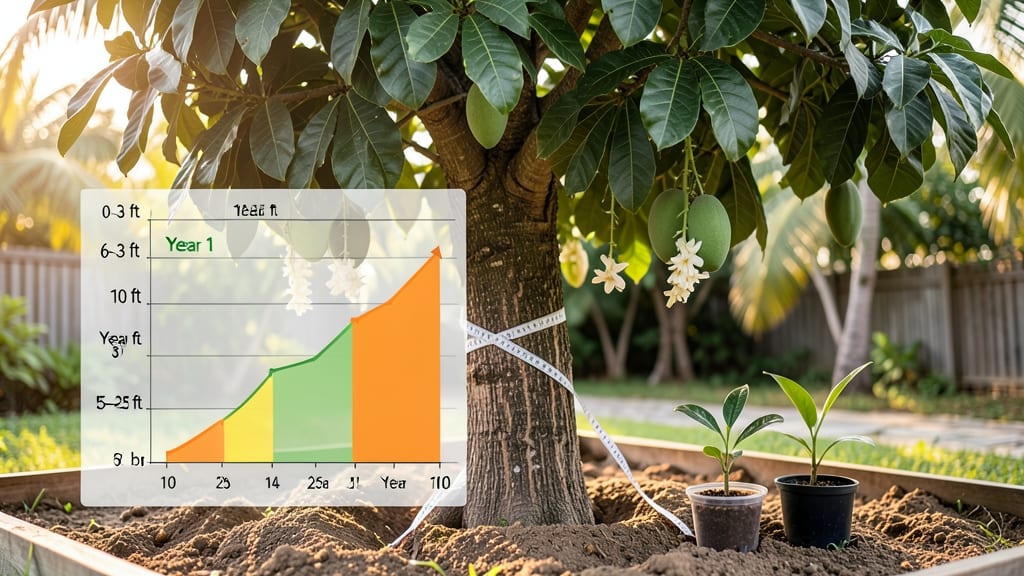
A mango tree’s growth rate can turn a 3-year wait into a decade-long saga — unless you know the right conditions to speed things up.
Picture this: You plant a sapling in spring, dreaming of juicy fruit by summer, only to watch it creep along at 1 foot per year while your neighbor’s tree explodes into a 20-foot giant in half the time.
What gives? The answer lies in variety, climate, and care — factors that can double (or halve) your tree’s progress.
From tropical Keitt varieties that shoot up 5 feet annually in Florida to subtropical Haden trees struggling to break 2 feet per year in California, the differences are staggering. Below, we break down the science behind these growth gaps and how to tip the scales in your favor.
You’ll discover which varieties mature fastest in your zone, how to read your tree’s growth signals, and the 3 biggest mistakes that stall progress — so you can finally enjoy that first homegrown mango without the wait.


Mango tree growth rate by variety: fastest vs slowest developers
If you're dreaming of homegrown mangoes, your mango tree growth rate depends heavily on the variety you choose. Some tropical varieties like Ataulfo can bear fruit in just 3 years, while others like Keitt may take 8+ years to reach maturity.
The difference comes down to genetics, climate adaptation, and how quickly each variety transitions from seedling to fruiting stage. Let’s break down the fastest and slowest developers so you can pick the perfect match for your garden.
Fast-growing varieties often thrive in tropical climates with year-round warmth, while slower-growing types may need subtropical conditions or extra care to reach their potential. For example, Haden mangoes—one of the most popular varieties—typically fruit within 5-7 years, but their growth slows significantly in cooler zones.
Meanwhile, Tommy Atkins, another hybrid favorite, can take 6-10 years to bear fruit, depending on your location. Understanding these timelines helps you plan for patience (or speed up growth with the right techniques!).
The Ataulfo variety stands out as the fastest developer, often fruiting in just 3-5 years and growing 3-5 feet per year in ideal tropical conditions. This makes it a top choice for gardeners in USDA Zones 10-11, like Florida or Hawaii, where warmth accelerates its growth.
In contrast, Carrie mangoes—while delicious—can take 8-12 years to bear fruit and grow at a sluggish 1-2 feet per year, even in perfect conditions. The trade-off? Carrie’s fruit is prized for its sweetness and size, but patience is key.
Hybrid vigor plays a huge role in growth rates. For instance, Haden mangoes combine the best traits of multiple varieties, resulting in faster fruiting (5-7 years) and moderate height (30-50 feet).
These hybrids often adapt better to subtropical climates, like Southern California or parts of Texas, where temperatures dip slightly in winter. If you’re in a cooler zone, choosing a hybrid like Haden can mean the difference between years of waiting and enjoying mangoes within a decade.
Climate isn’t just about warmth—it’s also about seasonal consistency. Mango trees in USDA Zone 10 (e.g., Miami) grow nearly year-round, while those in Zone 9 (e.g., San Diego) may experience slower growth during cooler months.
For example, a Tommy Atkins tree in Florida might fruit in 5 years, but the same variety in Arizona could take 8-10 years due to less consistent warmth.
Microclimates matter too: a tree planted near a heat-retaining wall or in a sheltered spot may outpace one exposed to cold winds.
Don’t overlook the role of soil and care in growth rates. Even the fastest variety—like Ataulfo—will struggle in poorly draining soil or with inconsistent watering. We’ve seen Ataulfo trees in Florida reach 20 feet in 4 years
How climate zones affect mango tree growth speed: USDA & tropical comparisons
Mango trees thrive in USDA Zones 10-11, where they grow 2-3 feet annually and fruit in 3-5 years. But in Zone 9 or colder, growth slows dramatically due to winter dormancy and cold stress.
Understanding these differences helps you set realistic expectations and use microclimate strategies to accelerate growth.
In tropical climates like Hawaii, mango trees grow aggressively—sometimes 4+ feet per year—thanks to year-round warmth and consistent rainfall. Meanwhile, in subtropical zones like Florida or California, trees may only grow 1-2 feet annually due to cooler winters and drought stress during dry seasons.
In Florida’s subtropical climate (Zone 9-10), gardeners use deep mulching and drip irrigation to protect roots during occasional cold snaps. For example, the 'Julie' variety thrives here, growing 3 feet annually with proper care.
In contrast, California’s coastal zones (Zone 9) require windbreaks to prevent salt spray damage from ocean winds.
For Zone 8 and colder, mango trees must be grown in containers and moved indoors during winter. Even then, growth is stunted—expect only 6-12 inches per year—but dwarf varieties like 'Cogshall' can fruit in 5-6 years with grow lights and humidity control.
My top microclimate strategy for marginal zones? Combine 3-4 inches of mulch with a windbreak fence and drip irrigation. This setup mimics tropical conditions, boosting growth by 30-50% even in Zone 9.
In Hawaii, where I’ve seen 10-foot mango trees in 2 years, the secret is rich volcanic soil and year-round warmth.
Cold stress isn’t the only challenge—drought and poor drainage also slow growth. Always plant in well-draining soil with organic matter, and water deeply 2-3 times per week during dry spells. With these adjustments, even Zone 9 gardeners can enjoy homegrown mangoes within a decade.