
Pruning
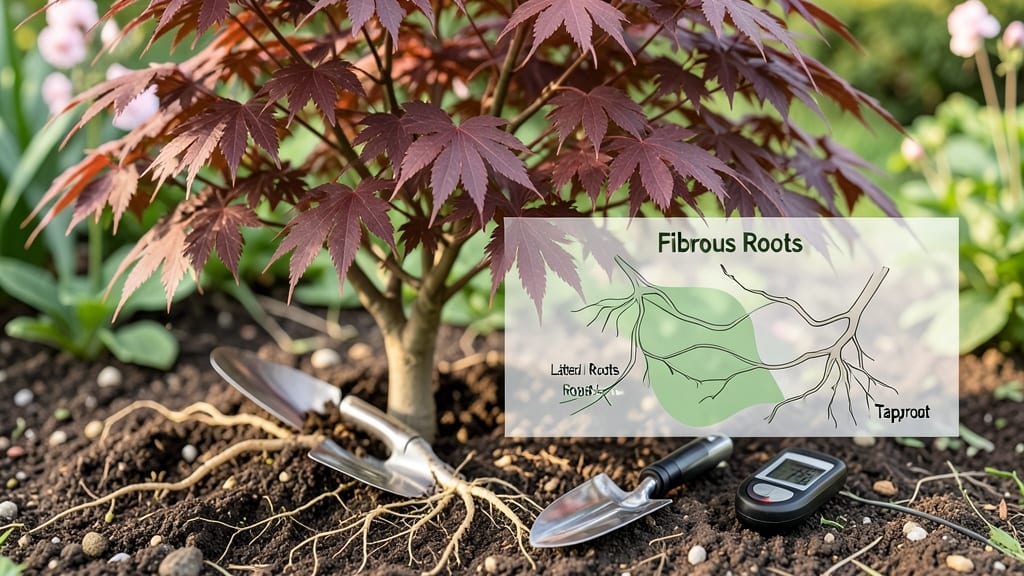
The Japanese maple tree root system is far more intricate than most gardeners realize, with shallow, fibrous roots that spread wider than the canopy itself.
Did you know your Japanese maple’s delicate canopy relies on a surprisingly complex root system that demands special care? Understanding its shallow, fibrous roots can mean the difference between a thriving specimen and a struggling tree.
These roots typically stay within the top 12-18 inches of soil, making them vulnerable to drought and compaction. That’s why mulching and proper soil prep aren’t just nice-to-haves—they’re essential for keeping your 🌿 Japanese maple healthy.
In this guide, you’ll discover how to protect those roots during planting, pruning, and seasonal care—plus the common mistakes that can stunt growth or even kill your tree.
Understanding Japanese maple root structure: depth, spread, and fibrous network
Japanese maples (Acer palmatum) are prized for their stunning foliage, but their shallow root systems make them uniquely sensitive to care. Unlike deep-rooted oaks, these trees develop a fibrous network that spreads widely but stays near the surface—typically within 12-18 inches of soil.
This structure supports their delicate branches while demanding gentle handling during planting, pruning, and maintenance.
Their root spread often extends 2-3 times wider than the tree’s canopy, which explains why they need ample space. For example, a 10-foot maple might have roots reaching 20-30 feet outward.
This wide reach also means they’re highly competitive for nutrients and water, making soil quality and moisture consistency critical factors for their health.
| Root Characteristic | Key Details | Care Implications |
|---|---|---|
| Depth | 12-18 inches | Avoid deep digging; protect topsoil |
| Spread | 2-3x canopy width | Plant 15+ feet from structures |
| Root Type | Fibrous (no taproot) | Sensitive to compaction; needs aeration |
| Density | High near trunk | Mulch to retain moisture |
Unlike trees with taproots, Japanese maples develop a dense fibrous network that prioritizes stability over deep anchoring. This adaptation helps them thrive in shallow, well-draining soils common in their native Japan.
However, it also makes them vulnerable to root damage from heavy foot traffic, compacted soil, or improper planting techniques.
Their shallow depth means roots absorb water and nutrients quickly, which is why consistent moisture is essential—especially during the first 2-3 years after planting. Drought stress can cause leaf scorch, while waterlogged soil leads to root rot.
Balancing these factors requires monitoring soil moisture and adjusting watering schedules based on seasonal changes.
Root density is highest near the trunk’s drip line, where fine roots create a sponge-like structure to capture nutrients. This is why mulching (2-4 inches of organic material) is crucial—it protects these delicate roots from temperature fluctuations and erosion.
Avoid piling mulch directly against the trunk, though, as this can suffocate the tree.
When transplanting, Japanese maples suffer more from root disturbance than deep-rooted species. Their fibrous system recovers slowly, so always dig a wide, shallow hole to minimize stress.
Amend the planting soil with compost or peat moss to improve drainage and nutrient availability, as their roots struggle in heavy clay or alkaline soils.
Another critical factor is soil aeration. Compacted soil restricts root growth, leading to stunted trees. To prevent this, avoid heavy machinery near the root zone and consider core aeration if planting in dense clay. Even established trees benefit from occasional soil loosening to encourage new root development.
Understanding these root characteristics helps explain why Japanese maples often struggle in urban landscapes with impermeable surfaces or poor drainage. Their shallow, spread-out roots can’t compete with lawn grasses or pavement encroachment. Always plant them in well-draining, slightly acidic soil (pH 5.0-6.5) and avoid areas prone to flooding.
For container-grown Japanese maples, the root system adapts by growing in a circular pattern around the pot’s edges. This makes them more prone to becoming root-bound, so repot every 2-3 years using a well-draining mix and prune circling roots during transplanting to encourage outward growth.
Finally, their nutrient absorption efficiency means they respond well to slow-release fertilizers applied in early spring. Over-fertilizing can burn their shallow roots, so always follow a balanced NPK ratio (10-10-10) and water thoroughly after application to distribute nutrients evenly.
By respecting their unique root structure—shallow depth, wide spread, and fibrous density—you’ll give your Japanese maple the stable foundation it needs to thrive for decades. 🌿🪴
Critical pruning insights for Japanese maple roots: what to avoid and when
When it comes to Japanese maple root pruning, timing and technique can make or break your tree's health. Unlike deep-rooted species, these trees develop a shallow, fibrous root system that spreads widely but stays close to the surface.
Disturbing these roots at the wrong time can lead to stress, disease, or even death—so knowing when and how to intervene is crucial.
Most gardeners only think about pruning the canopy, but root pruning is equally vital—especially during transplanting or when construction near the tree is unavoidable. The key is to minimize root loss while giving your tree enough time to recover before stress sets in.
Let's break down the essentials to keep your Japanese maple thriving.
🌱 Critical Mistakes to Avoid with Japanese Maple Roots
Over-pruning roots reduces nutrient absorption by up to 40%—never trim more than 25% of the root ball at once. Wrong timing (e.g., pruning in summer heat) can cause root desiccation. Always prune in early spring or fall when the tree is dormant.
For transplanting, the best time is late fall or early spring when temperatures are cool. Use a sharp spade or root saw to minimize tearing—never use dull tools that crush roots.
Aim to keep the entire root ball intact if possible, as even small losses can take years to regenerate.
If construction near your tree is unavoidable, root barriers can help—but they must be installed at least 18 months before work begins. This gives roots time to adjust.
For emergency situations, like root damage from excavation, prune only the damaged sections and focus on deep watering to stimulate recovery.
Recovery periods vary: young trees may bounce back in 1-2 years, while mature specimens can take 3-5 years. During this time, mulch heavily (3-4 inches) and water deeply weekly to support root regrowth. Avoid fertilizing during recovery—your tree’s energy should go to roots, not foliage.
One common mistake is pruning roots in drought conditions. Always water the area 24 hours before and after root pruning to reduce shock. Another pitfall is using string trimmers or lawnmowers near the trunk—these can sever shallow roots, leading to canopy decline and increased pest vulnerability.
When in doubt, consult an arborist for large trees or complex situations. With the right approach, your Japanese maple’s roots will stay strong, supporting that stunning foliage for decades to come. 🌿