
How To
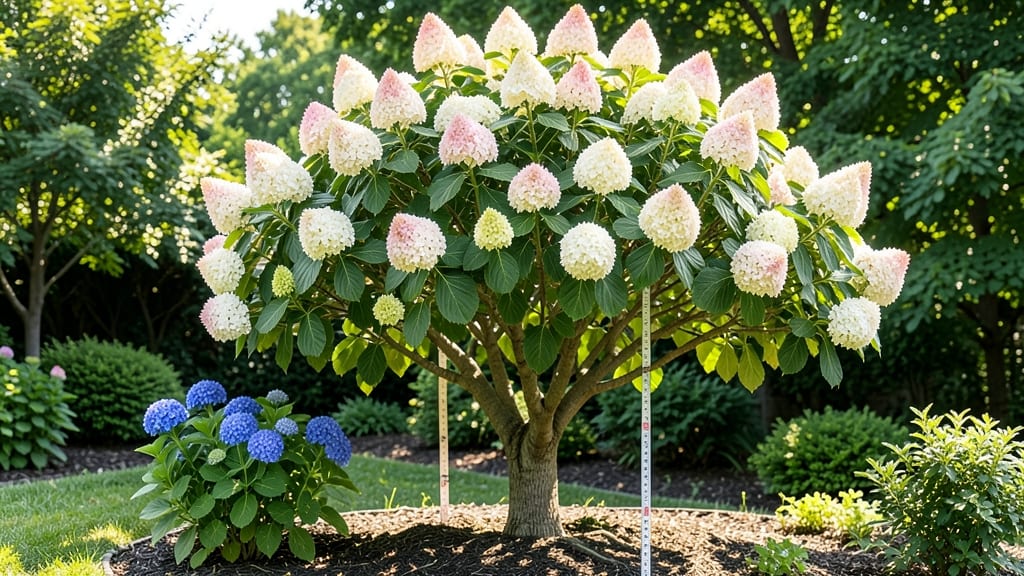
How tall a hydrangea tree grows can vary dramatically—from compact shrubs to towering giants 🌸—depending entirely on the variety and the care you provide.
If you’re dreaming of a stunning hydrangea tree but unsure whether it’ll tower over your patio or stay neatly contained, the variety you choose makes all the difference.
Some types, like Hydrangea paniculata, can reach 10 to 15 feet tall, making them perfect for large landscapes or as natural privacy screens.
On the other hand, dwarf varieties like Hydrangea arborescens ‘Annabelle’ stay between 3 and 5 feet, ideal for small gardens or container planting.


Hydrangea tree height by variety: from compact shrubs to towering giants
Choosing a hydrangea tree means balancing your garden’s vision with the plant’s natural growth habits. Some varieties stay neatly compact, perfect for small yards, while others grow into towering giants that make bold statements in large landscapes.
The variety you pick determines whether your hydrangea will be a privacy screen or a container-friendly accent. Let’s explore the height ranges of popular types so you can plan accordingly.
Hydrangeas belong to different species, each with distinct growth patterns. For example, Hydrangea paniculata varieties like ‘Limelight’ can reach 12-15 feet tall, while Hydrangea arborescens ‘Annabelle’ stays between 3-5 feet. Understanding these differences helps you avoid surprises as your plant matures.
Below, I’ve organized the most common types by their mature height, along with their growth habits to help you visualize their impact in your space.
| Variety | Mature Height | Growth Habit | Best For |
|---|---|---|---|
| Hydrangea paniculata 'Limelight' | 12-15 ft | Upright, pyramid-shaped | Large landscapes, privacy screens |
| Hydrangea paniculata 'Little Lime' | 6-8 ft | Compact, rounded | Small gardens, containers |
| Hydrangea arborescens 'Annabelle' | 3-5 ft | Bushy, multi-stemmed | Foundation plantings, borders |
| Hydrangea quercifolia 'Snow Queen' | 8-12 ft | Oak-leaf shaped, upright | Shady woodlands, specimen plants |
| Hydrangea macrophylla 'Endless Summer' | 3-5 ft | Bushy, mounding | Containers, patio gardens |
| Hydrangea paniculata 'Grandiflora' | 10-12 ft | Vase-shaped, sturdy stems | Backyard focal points, mixed borders |
If you’re working with limited space, dwarf varieties like Hydrangea arborescens 'Annabelle' or Hydrangea macrophylla 'Endless Summer' are ideal. These stay between 3-5 feet tall and thrive in containers or small garden beds.
For larger areas, Hydrangea paniculata varieties like ‘Limelight’ or ‘Grandiflora’ create dramatic vertical interest, often reaching 12-15 feet at maturity.
One key factor influencing height is the growth rate. Fast-growing types like Hydrangea paniculata can add 2-3 feet per year in ideal conditions, while slower growers like Hydrangea quercifolia take 3-5 years to reach their full height.
Always check the mature size on the plant tag or nursery description to avoid overcrowding in your garden layout.
Another consideration is the spreading habit. Some hydrangeas, like Hydrangea arborescens, grow wider than they do tall, making them perfect for foundation plantings or border edges.
Others, like Hydrangea paniculata, have a more upright, tree-like structure, which works well for privacy screens or backyard focal points. Measure your space carefully before planting to ensure your hydrangea fits comfortably.
For urban gardens or small patios, consider dwarf hydrangeas or miniature varieties. These are bred specifically to stay under 3 feet tall while still producing vibrant
How to control Hydrangea tree height: pruning tips for small spaces
Pruning your hydrangea tree isn’t just about keeping it tidy—it’s the secret to controlling its height and shape for your space. Different varieties respond differently to pruning, so understanding the right timing and techniques is key.
Whether you’re working with a compact hydrangea arborescens or a towering paniculata, mastering these steps will help you maintain the perfect size for your garden.
Before grabbing your pruning shears, know that late winter or early spring is the ideal time for most hydrangeas. This timing encourages new growth while avoiding the risk of damaging next year’s blooms.
For Hydrangea macrophylla, which blooms on old wood, prune immediately after flowering to avoid cutting off potential blooms. Meanwhile, paniculata and arborescens varieties bloom on new wood, so they can handle pruning in late winter.
Step-by-Step Pruning Guide for Hydrangea Trees
-
Step 1: Gather Tools
Use sharp, clean pruning shears for cuts, and have gloves and disinfectant ready to prevent disease. -
Step 2: Identify Dead or Weak Branches
Remove any diseased, crossing, or inward-growing branches first to improve airflow and shape. -
Step 3: Prune for Height Control
For taller varieties, cut back 1/3 of the tallest stems to the nearest bud or joint. Aim for a balanced, open shape. -
Step 4: Shape the Canopy
Thin out overcrowded branches in the center to let light reach inner foliage and encourage blooming. -
Step 5: Clean Up
Rake up clippings and debris to prevent pests or fungal growth. Disinfect tools with rubbing alcohol.
If your hydrangea tree is already too tall, don’t panic—you can still reduce its height gradually. Focus on cutting back the longest branches first, making sure each cut is just above a bud or outward-facing leaf.
This encourages new growth in the right direction and prevents a lopsided shape. For dramatic height reduction, you can even prune up to 50% of the plant’s height in one season, though this may take a year or two to fully recover.
For small-space gardening, consider dwarf varieties like Hydrangea arborescens ‘Annabelle’, which tops out at 3–5 feet, or Hydrangea paniculata ‘Little Lime’, a compact version reaching 4–5 feet.
These varieties are low-maintenance and perfect for containers or tight yards. Even with these, a little annual pruning keeps them neat and blooming without overpowering your space.
Remember, consistency is key. Regular pruning—even just light shaping twice a year—helps maintain your hydrangea’s desired height and health. Always prune just above a bud at a 45-degree angle to encourage faster healing and growth.
With the right approach, your hydrangea tree will stay beautifully proportioned and flourishing for years to come. ✂️🌿🌸