
Propagation
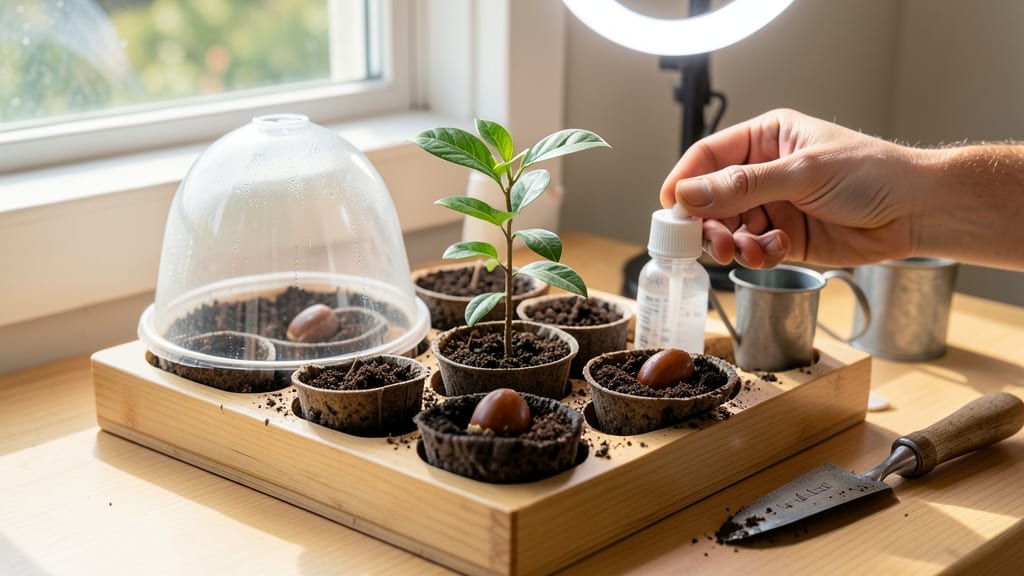
Starting a persimmon tree from seed takes three years before fruit—but that first ripe orange slice makes every season worthwhile. 🌱 I learned the hard way that persimmons need cold stratification to break dormancy, and skipping this step means waiting months longer for germination.
The key is patience, a damp paper towel, and a fridge visit before planting.
Here's the secret: soak your seeds in warm water for 24 hours first, then wrap them in a damp paper towel and refrigerate for 60-90 days. This mimics winter's natural chilling period.
Most seeds sprout within 2-4 weeks after moving to a sunny windowsill or seedling tray with well-draining soil. The first leaves are delicate, so keep humidity high with a plastic dome until roots establish.
You'll watch those first true leaves unfold into a 5-foot sapling by year three, ready for transplanting outdoors. The real magic happens when you finally taste your homegrown fruit—sweet, custard-like perfection that store-bought varieties can't match.
Just be ready for a 10-year wait for full production, but every gardener who's grown one will tell you it's worth it.
This method works for both American and Asian persimmons, though Asian varieties may need a slightly longer cold treatment. For best results, plant in full sun with well-draining soil, and protect young trees from late frosts.
The payoff? A tree that'll feed you for decades with minimal care after that initial patience investment.
Seed Germination Struggles Explained
Understanding why persimmon seeds sometimes fail to sprout—or grow slowly—can save you time and frustration. Here’s a breakdown of the key reasons behind these challenges, with actionable science to help you troubleshoot.
Persimmon seeds often enter a natural dormancy phase, a survival strategy that delays germination until conditions are ideal. This happens because:
- Hard Seed Coat: The thick, woody outer layer (testa) blocks water and oxygen, preventing the embryo from activating.
Persimmons (Diospyros spp.) rely on this trait to survive harsh winters or dry spells in the wild. - After-Ripening Requirement: Even after extraction, seeds may need weeks to months of cold, moist stratification (mimicking winter) to break dormancy.
Without this, the seed stays "asleep," waiting for the right signals.
Actionable Fix: Soak seeds in warm water for 24–48 hours, then rub gently with sandpaper to scratch the coat. For stubborn seeds, stratify by mixing them in damp peat moss and refrigerating for 6–12 weeks before planting.
Persimmon seeds are temperature-sensitive. Too hot or too cold can stall germination:
- Cold Shock: If soil temps drop below 50°F (10°C), metabolic processes slow or halt. Early spring or fall planting without protection can leave seeds dormant. - Heat Stress: Above 90°F (32°C), seeds may dry out or develop fungal infections before sprouting.
Direct sunlight on bare soil accelerates this risk.
Actionable Fix: Plant seeds in well-draining, partially shaded soil (like under a nursery shade cloth). Use a seedling heat mat (set to 70–75°F/21–24°C) if starting indoors, or wait until soil temps stabilize at 60°F (15°C) before outdoor planting.
Water is the lifeblood of germination, but persimmon seeds need consistent, not soggy conditions:
- Overwatering: Excess moisture suffocates seeds by cutting off oxygen or triggering rot (especially in compacted or clay-heavy soil).
- Underwatering: Drought stress causes seeds to shrink and harden, trapping the embryo in a dry, inactive state.
Actionable Fix:
- Outdoors: Keep soil moist but not waterlogged (like a wrung-out sponge). Use a mulch layer (straw or pine needles) to retain humidity.
- Indoors: Use a propagation tray with drainage holes and mist seeds lightly daily. Avoid submerging them in water.
Seeds exposed to pathogens or poor hygiene often fail to sprout:
- Fungal Infections: Moldy seeds (gray, fuzzy growth) indicate Rhizoctonia or Pythium, which rot the embryo. This happens in humid, poorly ventilated setups.
- Bacterial Soft Rot: Overripe or damaged seeds attract bacteria that consume the seed’s nutrients, leaving nothing for the sprout.
Actionable Fix:
- Sterilize tools (pruners, containers) with rubbing alcohol.
- Use sterile potting mix (avoid garden soil). Add 1 part perlite to 3 parts coco coir for airflow.
- Discard moldy seeds immediately—don’t risk spreading spores.
Not all persimmon seeds are created equal:
- Old or Stored Seeds: Seeds lose viability over time. Persimmons typically stay viable for 1–2 years if stored dry and cool (below 40°F/4°C).
After that, germination rates plummet. - Improper Extraction: If the seed was damaged during removal (e.g., crushed or dried out), the embryo may be nonviable.
Actionable Fix:
- Test viability by floating seeds in water: Sunk seeds = likely viable; floating seeds = discard.
- Use fresh seeds from fully ripe, healthy fruit (avoid store-bought persimmons, which are often treated to prevent germination).
Quick fixes for seedling struggles
Growing a persimmon tree from seed is a rewarding but delicate process—especially when your little sapling hits a snag. Below are practical, step-by-step solutions for common challenges, paired with prevention tips to keep your seedling thriving. No gardening degree required!
Why it happens: Persimmon seeds need the right conditions to break dormancy—too dry, too cold, or improper scarification can stall growth.
How to fix it:
- Soak seeds overnight 💧
- Place seeds in a bowl of warm water for 12–24 hours before planting. This mimics natural rain and softens the hard outer shell.
- Scarify stubborn seeds ⚒️
- If seeds stay hard after soaking, gently sandpaper the outer coat (focus on one side) or nick it with a knife. Never fully remove the shell—just rough it up!
- Use a heat mat or warm spot 🔥
- Persimmon seeds germinate best at 70–80°F (21–27°C). Place your seed tray near a sunny window, on top of a fridge, or use a seedling heat mat.
- Plant deeper than expected 🏗️
- Bury seeds 1–1.5 inches deep in moist, well-draining soil (sandy loam works best). Deeper planting reduces moisture loss and mimics forest-floor conditions.
Prevent future issues:
- Test seed viability first: Float seeds in water—sinkers are viable; floaters are likely dead.
- Keep soil consistently moist (not soggy!) with a spray bottle or drip irrigation.
- Label your seeds with the planting date to track germination timelines (usually 2–4 weeks).
Why it happens: Overcrowding, poor light, or uneven watering causes seedlings to stretch toward any available light, weakening their stems.
How to fix it:
- Thin seedlings early ✂️
- Once seedlings sprout true leaves (not the initial seed leaves), snip the weakest ones at the base, leaving the healthiest 2–3 per pot.
- Move to brighter light ☀️
- If seedlings are pale or leaning, they need more light. Gradually shift them to a south-facing window or use a grow light (12–14 hours/day).
- Fertilize lightly 🌿
- After 4–6 weeks, use a balanced, diluted fertilizer (5-5-5 or 10-10-10 at ¼ strength). Over-fertilizing burns tender roots!
- Rotate pots weekly 🌀
- Turn pots ¼ turn daily to prevent lopsided growth toward the light source.
Prevent future issues:
- Start with individual pots (not trays) to avoid overcrowding.
- Use a self-watering system to maintain even moisture without drowning roots.
- Avoid cold drafts—persimmons hate temperature swings below 50°F (10°C).
Why it happens: Fungal infections (like damping off) or pests (aphids, spider mites) target stressed seedlings.
How to fix it:
| Pest/Disease | Fix It Fast | Prevent It |
|---|---|---|
| Damping Off (mushy stems) | Remove affected seedlings, sterilize soil with hydrogen peroxide (1 part H₂O₂ to 10 parts water), and repot in fresh, dry soil. | Use sterilized potting mix and avoid overwatering. |
| Aphids (sticky leaves) | Spray with soapy water (1 tsp mild soap + 1 quart water) or introduce ladybugs. | Keep plants healthy—stress attracts pests! |
| Spider Mites (webbing) | Wipe leaves with neem oil solution (1 tsp neem oil + 1 quart water + drop of dish soap). | Increase humidity with a pebble tray under pots. |
| Fungal Spots (yellow/brown leaves) | Prune infected leaves, improve airflow, and treat with copper fungicide. | Water at the base (not overhead) and space seedlings apart. |
Prevent future issues:
- Inspect seedlings weekly for early signs of trouble.
- Quarantine new plants for 2 weeks before introducing them to your garden.
- Use organic mulch (like straw) to deter soil-borne diseases.
Why it happens: Nutrient-deficient soil, root-bound pots, or transplant shock can stall growth.
How to fix it:
- Repot into larger containers 🏺
- Once roots circle the pot, upgrade to a 3–4 inch pot with fresh, airy soil (mix 50% potting soil + 50% perlite).
- Add organic matter 🍂
- Mix in compost or worm castings for a nutrient boost. Avoid synthetic fertilizers until the seedling is 6+ inches tall.
- Check for root rot 🚨
- Gently remove the seedling from its pot. If roots are black/mushy, trim the bad parts and repot in dry soil.
- Hardening off outdoors 🌱
- Acclimate seedlings to outdoor conditions gradually (start with 1 hour/day, increasing over 2 weeks). Shield from direct sun at first!
Prevent future issues:
- Use well-draining soil (persimmons hate soggy feet!).
- Avoid over-potting—too much space can delay root establishment.
- Monitor for nutrient deficiencies (yellow leaves = nitrogen; purple stems = phosphorus).
💡 Pro Tip: Persimmon seedlings are slow starters—don’t rush them! Focus on consistency (water, light, soil) over speed. With patience, your seedling will reward you with vibrant growth and—eventually—sweet, orange fruit! 🍊✨
Frequently asked questions
How long does it take for persimmon seeds to germinate after stratification?
After completing the 60-90 day cold stratification, most persimmon seeds germinate within 2-4 weeks when kept in warm (70-80°F/21-27°C) conditions. Some varieties may take slightly longer, especially if the seeds were older or didn't receive proper scarification. Keep the soil consistently moist but not soggy during this period.
Can I use store-bought persimmon fruit for seeds?
Store-bought persimmons are often treated to prevent germination, so they won't produce viable seeds. For best results, use seeds from fresh, fully ripe persimmons you've grown yourself or harvested from a local tree. The seeds should be plump and firm, not shriveled or damaged.
What's the best soil mix for persimmon seedlings?
Persimmon seedlings thrive in well-draining soil with a mix of 50% potting soil and 50% perlite or coarse sand. This prevents waterlogging while retaining enough moisture. For outdoor planting, amend native soil with compost to improve drainage and fertility. Avoid heavy clay soils that can suffocate young roots.
How do I know when my persimmon seedling is ready for transplanting outdoors?
Your seedling is ready when it reaches 12-18 inches tall and has developed a sturdy stem with several sets of true leaves. Harden it off by gradually exposing it to outdoor conditions over 2-3 weeks before transplanting after the last frost date in your area. Choose a sunny location with well-draining soil.
Will my seed-grown persimmon tree produce fruit as good as a grafted one?
Seed-grown persimmons may take 10-15 years to bear fruit, and the quality can vary more than grafted trees. However, the fruit will be true to type and may offer unique flavors. For consistent, high-quality fruit, consider grafting your seedling with a known variety once it's established. Many gardeners enjoy the adventure of growing from seed for the novelty of the experience.